


Originally released in January 2017, Resident Evil 7 acted as somewhat of a soft reboot for the zombie survival horror series focusing on first person horror, tense survival, and a single claustrophobic environment to explore.
While the game was fantastic, I really struggled to play it due to its first person gameplay perspective. Sure it improved the horror tension of the experience, but it also meant I couldn’t play for more than an hour or so at a time, if I was well rested and in peak condition, without becoming ill.
Resident Evil 8 released in May 2021 and, at launch, also featured a mandatory first person perspective. While this entry in the series skewed a little more toward action setpieces and open environments, the game was still only playable in first person for multiple years.
A third person mode was eventually released for Resident Evil 8, but only as part of a paid DLC bundle which included new story content. This was a bit disappointing at the time, as publisher Capcom had only recently released a free accessibility update for the game. By not including this third person mode in that free accessibility update, and instead making it part of the paid story DLC, it seemed like Capcom either didn’t see third person support as an important accessibility feature, or like they were happy to lock an accessibility feature behind a paywall.
To that point they did acknowledge that it was better for motion sick players in the announcement video, so it really feels like it might have been the latter.
As much as I enjoyed Resident Evil 7 and 8, both games caused me frequent enough illness issues that I found them, ultimately, hard to enjoy without making myself unwell. That inevitably impacted how positive I could feel about either game.

Resident Evil 9: Requiem finally released last week and, much to my delight, the game released with support for third person gameplay. As a result I’ve had a much easier time playing through Requiem compared to 7 and 8, and have been much better able to enjoy what this new entry has to offer.
Resident Evil: Requiem is, at its core, a game of two halves. In portions of the game you play as Grace Ashcroft, an FBI agent kidnapped by a mad scientist doctor who believes her blood has unique properties he must extract. The other half of the game sees players take on the role of Leon Kenedy, long running series protagonist and huge fan of slicing up infected with chainsaws.
By default Grace’s sections of Requiem are played in first person, and very much lean into the claustrophobic survival horror / locked building puzzle solving seen in Resident Evil 7. Ammo and healing items are scarce, monsters roam the halls that might as well be unkillable, your inventory space is highly limited, and you’ll frequently be on the lookout for mysterious gems to unlock doorways with.
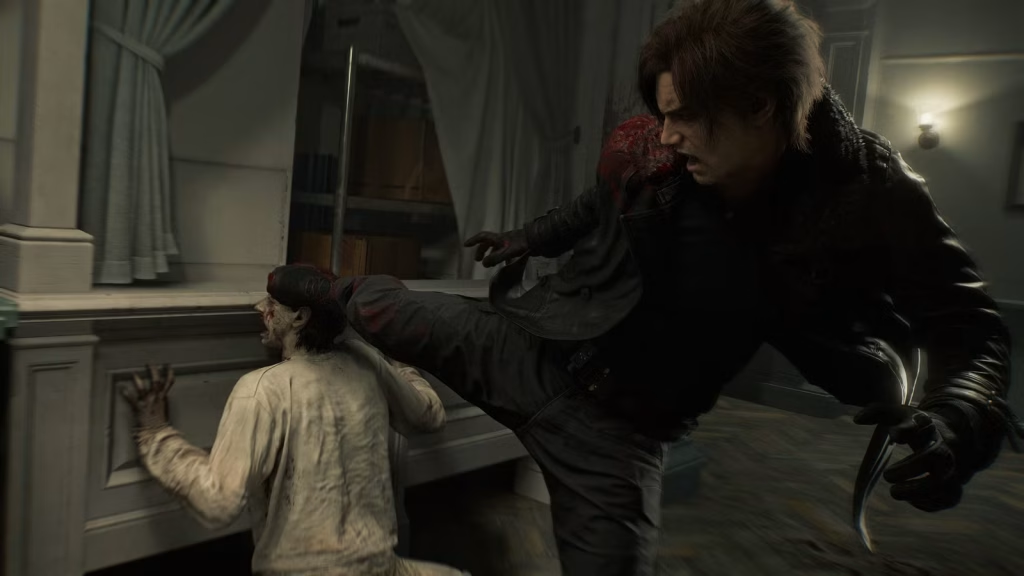
Leon’s sections of the game, by comparison, take the action combat elements seen in Resident Evil 4 and amp them up, making Leon a near invincible killing machine. At times veering closer to Resident Evil 5 or 6 in action tone, Leon’s sections of the game are by default played in third person and focus almost exclusively on fighting waves of enemies. Ammo is plentiful, you can take more damage before collapsing, and you’ve got more tools with which to defend yourself.
When first booting up Requiem, players are shown the game’s first person and third person gameplay split, with explanations for why the developers chose those camera perspectives per character. Players are given the choice to change those selections before gameplay begins.
The ability to play the full game in third person is hugely important for motion sickness reduction, and I’m very glad that Requiem allows playing Grace’s sections of the game that way, but there are some important exceptions to being able to play as Grace in third person.
Certain cutscenes, combat encounters, and button mashing sequences when playing as Grace will still be forced into first person perspectives, such as an early sequence when fleeing a hotel with Grace’s mother, and a sequence early on when fighting a zombie police officer. While it’s mechanically understandable why some of these sequences are forced into first person, it is a little disappointing that these exceptions are not mentioned to the player in advance.
Subjectively, as someone who suffers chronic motion sickness, these forced first person moments have been infrequent enough, and short enough in duration, not to trigger my experiences of motion sickness. They don’t pose an issue for me, but individual mileage will vary.

Sticking with Grace’s portions of the game initially, these more tense survival sections can at times be a little overwhelming in terms of navigation and resource management.
When playing on the default difficulty mode it is possible to use up all available ammo and healing items in an accessible area of the game, ultimately forcing the player to brute force running past threats to try and reach progression points. Grace doesn’t have any default healing options or persistently available damage options to fall back on, so you’ll want to be cautious when you use ammo and healing items, often stunning and running from enemies often instead of trying to actually kill them.
It’s also not always initially clear the route to progression in some of the early game’s more backtracking heavy interior areas.
Limited inventory space is also somewhat of a challenge in early parts of Grace’s story, with an optional location for upgrading Grace’s capabilities easy to accidentally miss discovering.
Taking a slight step back, Resident Evil: Requiem features a series of accessibility settings that do a decent job of making the game more comfortably playable by a range of disabled players.
On first boot of the game, players are told about a series of accessibility presets offered for Auditory, Visual, Motor, and Motion Sickness categories. While not activatable during initial boot up, it is positive that the existence of these accessibility presets is prominently highlighted.
In the Controls menu players can set their default movement type from walk to run, change run from a hold to a toggle, change repeated tapping inputs into a button hold, and activate a series of aiming assistance features.
Requiem’s Aim Assist comes in two forms, Aim Snap and Aim Follow. Aim Snap moves your reticle to an enemy with a flick of the right analogue stick then leaves that analogue stick in a static position, while Aim Follow continues to track the enemy as it moves after snapping to them. Aim Follow feels really solid in practice – It isn’t a cheat code to win combat, enemies are often bullet sponges where you’ll still be challenged by dodging their attacks, but the movement to and tracking of enemies is really well designed.
Players can also choose whether or not to aim first person down sights when aiming with select weapons.
In the Camera menu, players can toggle 1st and 3rd person camera perspective, invert camera controls either when or in standard gameplay, reduce camera wobble, and on platforms like Switch 2 turn on motion controls for aiming.
In the HUD menu players can increase HUD size, increase menu text size, turn off the on screen health gauge, turn off notifications of various types, turn off their aiming reticle, turn on a persistent centre screen dot, and alter their reticle, scope, or dot colours.
In Graphics, motion sickness prone players can turn off motion blur.
In Audio, players can tweak volumes for different sound categories via sliders, and alter the dynamic range of volume (if for example sudden volume spikes are likely to cause you issues).
In Language players can turn on Subtitles and Closed Captions, alter subtitle and caption size and colour, add a subtitle background, display speaker names, and change speaker name colours.
Requiem’s dedicated accessibility menu basically just explains which settings the accessibility presets will tweak, and offers the ability to toggle those presets on.
On the default and more casual game difficulty modes Requiem features autosave support, but in higher difficulties players will have limited locations to manually save, and only be able to do so by finding a consumable item in game, limiting their total save slot availability.
Ultimately, as someone who really enjoyed both Resident Evil 7 and 8, my biggest issue with both games was their forced first person perspective – It’s obviously hard to enjoy playing a video game that’s actively making you ill as you explore it. Resident Evil 8 making third person support an optional paywalled add-on never sat quite right with me, and I’m hugely glad that the mode is supported in Requiem for free, at launch.
Resident Evil 9 has, in my opinion, done a fantastic job of representing both extremes of the series history, both tense challenging survival horror puzzle exploration and over the top infected slaying action, side by side in one connected narrative. I’m really enjoying both aspects of this game, and feel relieved that I get to binge it in lengthy gameplay sessions this time.
It’s nice when games that I enjoy don’t make me need to lie down in a dark room, trying to stave off nausea and dizziness. It’s a low bar, but I appreciate when games are able to clear it.