 By
By 
Over the past week I’ve put around 60 hours into playing through Pokémon Legends Z-A on the Nintendo Switch 2, and it’s safe to say I’m hooked. This is hardly a surprise, I’m a notorious Pokémon obsessive, I was always going to find something here to enjoy if I could collect creatures, and some of them might be a rare colour variant.
At this point in my playthrough I am pretty close to completing all base game objectives outside of my own desire to shiny hunt – I’ve completed the Pokédex, the main story, and all side objectives. I’ve got some crystals to shatter, some fights to win, a few mega evolutions to wield, and one special Pokémon encounter left before I get the Shiny charm and start obsessively hunting for rare creature variants.
However, with this all said, I’ve got a number of accessibility related thoughts on Pokémon Legends Z-A now that my adventure is nearing completion, as well as some shiny hunting impressions which in my opinion has accessibility relevance in terms of its overlaps with avoiding paranoia and obsessive loops for gamers like myself who are autistic.
Starting with the elephant in the room – let’s talk about combat. Pokémon Battles in Legends Z-A are real time battles, rather than the series usual turn based encounters. Moves are no longer balanced by giving more powerful attackss fewer uses, and now balanced with longer cooldowns between uses for stronger moves.
General impressions personally on combat, I personally really enjoy this direction for the series. It still feels pretty similar to the series traditional combat system in many ways, sort of like if you watched a Dungeons and Dragons fight in real time. It takes a second to adjust to the fact a full round of actions Dungeons and Dragons actions canonically takes just 6 seconds to play out, but if you can keep up with the speed it’s the same fight just at a snappier pace.
However, there are some obvious accessibility barriers present that were not previously part of the series core combat design.
Players will need to be comfortable using two analogue sticks to run and turn the camera during fights, with L2 needing to be held down constantly to lock the camera onto an enemy Pokémon, as doing that is necessary for accessing the attack selection menu. Items are now also on a cooldown when in battle, to avoid their overuse.
Certain attacks that were previously effective for a guaranteed one turn window are in many cases now reaction based, such as Protect. Players wishing to block an incoming attack will now need to see an incoming attack, recognise its animation and what attack it is, how long it’s going to take to hit them, and time their use of Protect to line up with the incoming attack. I’ll be honest, as someone with a timing and coordination based disability, I really never got the hang of this timing for using Protect at all.
Certain other moves now leave stage hazards in the arena, such as Stealth rocks, requiring the trainer to lead their Pokémon away from danger before attacking.

Much like Legends Arceus, in Legends Z-A enemy Pokemon attacks can sometimes hit the player character. This typically isn’t a major factor in standard battles, but often comes up in Rogue Mega Evolution boss fights, a mix between raid battles and Legends Arceus style boss fights. In these encounters the player will be required to dodge roll out of the way of certain incoming attacks, with too many hits against the player in a short period of time causing a failed battle even if your team of creatures still has health remaining. These encounters are mandatory to complete the game and to capture certain rare creatures, and in some cases struggling with this mechanic may be a barrier to progression.
The other traversal tool in your arsenal is sprinting, which is thankfully by default a toggle rather than a button hold, with no stamina limit.
In addition you can click in L3 to crouch and sneak, useful for not being spotted by wild Pokémon, but also important in NPC battle arenas at night, as sneaking up on an enemy trainer without being seen grants an attack of oportunity that deals bonus damage at the start of the fight.
Combat is going to be inherently a little less accessible here for players with coordination or reaction time impacting disabilities, as well as other motor accessibility conditions, and vision related disabilities.
Additionally, fights are more visually overstimulating than in many past series entries, with more pressure to react quickly, and less room for downtime between inputs.

Pokémon Legends Z-A does feature a settings menu, but its contents are pretty sparse. You can disable rumble, increase or decrease text speed, set the minimap to rotate or remain static, invert the camera and tweak sensitivity, and adjust three very basic audio sliders. There is no in game button remapping option. For those of you who struggle with stick click inputs L3 is used to crouch, and mega evolution is mapped to R3, unless you remap these in the Switch system settings.
For players like myself who found that the Pokédex completion tasks in Legends Arceus were particularly satisfying (I’m the kind of autistic player who loves a good list to chip away at completing), a similar but slightly different system is present in Legends Z-A. Rather than being tied to specific creatures Pokédex entries, here there’s a more broad list of objectives to complete that grants rewards, upto and including the game’s Shiny Charm. These generally are more broad than in Legends Arceus, focusing on capturing specific numbers of creatures of an elemental type, completing your Mega Evolution Pokédex entries, and completing a perhaps obscene number of NPC trainer battles. It doesn’t offer species specific rewards and challenges like Legends Arceus’s boosted shiny odds, but it does still scratch a similar completionism itch.
Evolving Pokemon and teaching them new moves is, by default, done in the pause menu after battles have ended. This isn’t an optional setting you can toggle on or off like it was in Scarlet and Violet. While making evolutions and move learning something done outside of battle does help to keep the game moving at a very snappy pace, it does mean there’s a degree of cognitive load involved in remembering to update your team’s movelists regularly if you, like me, have ADHD and forget to do these upkeep tasks sometimes if not prompted to do them exactly at that moment.
If at any time you want to switch Pokémon in your party, your storage boxes are accessible at any time from the menu, with no penalty for switching out creatures to better fit a scenario.
When in the wild you may be attacked by multiple wild Pokémon at once. This can be a bit overwhelming, and may make certain areas difficult to explore if you’re struggling with the dodge roll mechanic.

While exploring Lumiose, the single densely populated city where Legends Z-A takes place, you may encounter platforming challenges in the form of scaffolding. While climbing these is usually optional, there are a number of sidequests, collectables, and unlockable events sometimes locked behind navigating their jumps and narrow walkways, in some cases under a time constraint. While there’s no fall damage, these may be a barrier to certain optional game unlocks.
The opening hours of Legends Z-A are very linear and restrictive when compared to Arecus or Scarlet and Violet, with at multiple points invisible walls put up to enforce having you follow the opening hours of the plot. While ultimately not a big deal this did cause me a little initial frustration as I kept trying to wander just slightly off path to pick up collectables in line of sight, before being told not to walk off.
Pokémon Legends Z-A is absolutely full of sidequest content, with over 100 sidequests popping up on the map during my playthrough. While I generally really enjoyed these little slices of world building content, they can be a little overwhelming if you’re a completionist style player. Often I would clear all present sidequests, progress one main story cutscene, and return to another 10 sidequest markers suddenly on my map. It took a little adjusting to get comfortable with that.

While the opening hours of Legends Z-A make it seem like the game is going to be split into two sharply distinct halves, capturing creatures in the day and fighting trainers at night, the boundary between these halves of the game is honestly a lot more fuzzy and flexible than it seems. While time of day does change automatically, you can rest at benches to skip between day and night to avoid waiting around to get back to a time specific creature hunt or battle quest.
TM’s are also no longer single use, meaning that you can teach a move to a Pokémon without stressing over using up a single opportunity for the move to be taught.
Pokémon in the wild can be caught without battling like in Legends Arceus, but now also feature a number of upward pointing arrows to help display how easy they’re going to be to catch at their current health and with a selected type of Pokéball.
Additionally, if you accidentally knock a Pokémon down to 0HP, in Legends Z-A you have a single chance to catch it with elevated catch odds before it disappears. Also, any Pokéballs you throw that don’t hit their target can be collected from an NPC found at Pokémon Centres.
Lastly, let’s talk about online competitive battles and shiny hunting.

Pokémon Legends Z-A has a ranked online battle system, and certain mega evolution items are locked behind engaging with these online ranked battles. Players will need to reach rank K in the online multiplayer rankings, starting from Z and working up to A, to receive these Mega Evolution rewards, which understandably has been concerning for some players.
Having played up to rank A in this system myself, I want to explain a little bit about how these ranked battles work. I don’t like that these rewards are locked behind this system from an accessibility perspective, but I also don’t believe it’s likely to be as big of a barrier as it seems for many players.
So, in short, ranked online multiplayer matches in Legends Z-A are 3 minute long, four player free for alls. Players bring a team of 3 Pokémon and can switch their active creature out 3 times, with that limit being reset upon being knocked out. Players have no set number of lives, and score points by landing the knock out blow on an enemy Pokémon.
They do not lose points for being knocked out.
While there are progression points awarded for coming in 1st and 2nd, with negative ranking points for 3rd or 4th place, these are ultimately pretty easy to overcome. These online ranked matches have a bunch of other ways to earn bonus ranking points such as points per knockout you achieved (even if you came in last), being the first to pick up an item off the ground, knocking out two Pokémon with a single attack, knocking out a mega evolved pokémon, Mega Evolving yourself the most frequently, and a huge number of other variables.
Coming in 4th place in an online match, but knocking out 4 enemy Pokémon during 3 minutes, will still net you a positive number of points in the ranking system. Mius 30, plus 40, brings you to 10. It’s very possible to come in last place and not only break even, but slightly raise your ranking standing.
If you play aggressively, going for knockouts and not stressing too much about the points you’re giving others, you can very much rise the ranks even if losing. You can have a match where all four players at the end get net positive points, depite someone losing. In the match that I’ve included footage of in this video, I came in 4th place at rank A, and still had a net positive in ranking points.
While I’m not a fan of locking these mega evolution stones behind ranked online play, I do think that rising the ranks here is pretty friendly in its implementation, compared to other online ranked multiplayer games. I generally suck at real time online ranked competitive games, and I made it to rank A in a single evening. Rank K is not as scary of a hill to climb as it sounds like.
Lastly, let’s quickly talk about shiny hunting in Pokemon Legends Z-A.
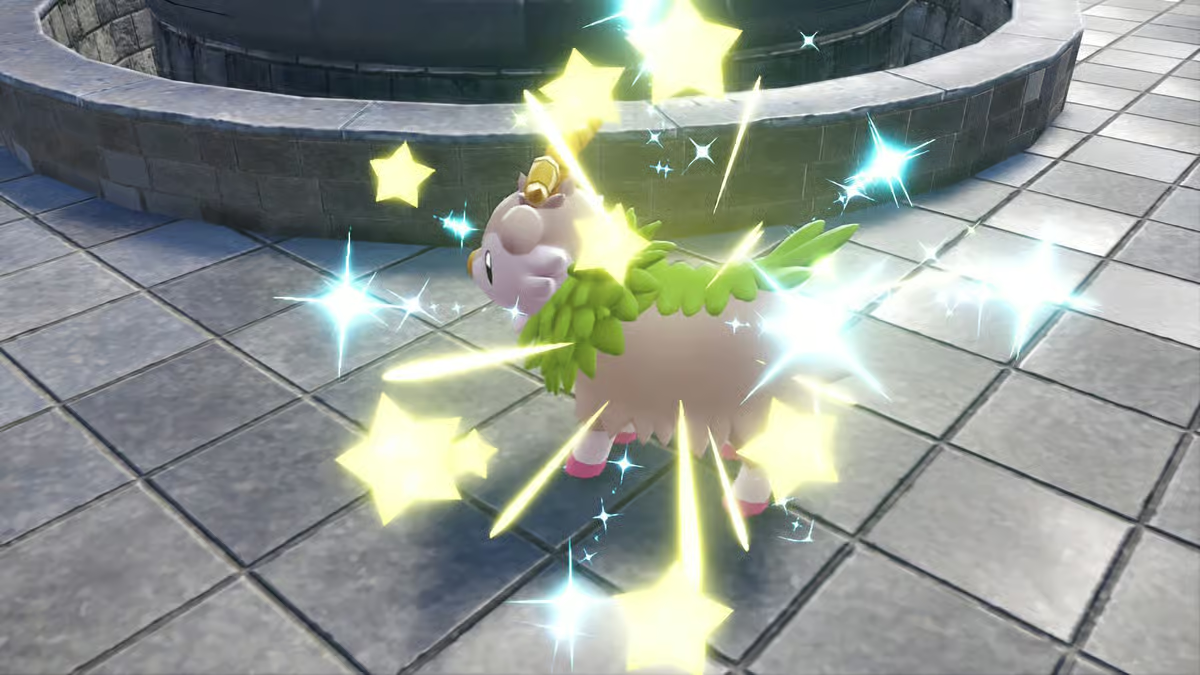
A quick refresher, in modern Pokémon games each creature encountered has a 1/4096 chance to spawn as a rare colour altered variant called a shiny. These creatures don’t do anything special, but they are fun to collect.
Unlike multiple recent entries in the series, the only way to increase your Shiny odds in Legends Z-A is to obtain the game’s Shiny Charm, increasing your shiny odds to 1/1024.
Much like Legends Arceus, Shiny Pokémon feature a visible sparkle animation and sparkle sound effect when spawning nearby, making them easier to locate. Additionally, in Legends Z-A Shiny Pokémon feature a glittering visual effect in the overworld, and a shiny icon when targeted. Additionally, some hard to spot Shiny Pokémon like Splowpoke have been redesigned to be easier to see as shiny in the wild.
At release there was some concern regarding the fact that Legends Z-A features mandatory autosaves, which some shiny hunters worried could make it easy to accidentally lose out on a Shiny and then have the game save after a failed catch. However, those worries are unfounded for a couple of reasons.
Legends Z-A will only autosave after you successfully catch a Pokémon, complete a story event, or complete a battle with an NPC trainer. Knocking a Pokémon out, scaring it into running away, or failing to catch it do not trigger auto saves, meaning that you can manually save in front of a shiny and failing to catch it won’t put an auto save down, allowing you to reset and try again from your manual save.
In addition, there’s a really interesting mechanic at play behind the scenes that makes it very hard to fail a shiny encounter by accident.
When you travel through a loading zone, fast travel, or rest at a bench, all Pokémon within 50 meters of your loading position are rolled to see if they are shiny.
If a Pokémon is determined to be shiny, the game has 10 hidden slots in memory where it will save the location and species of that shiny creature, and basically lock it in place.

Where prior games in the Pokémon series would often reroll a shiny into no longer being shiny anymore if you travelled away to get more Pokéballs or fast travelled to a different area, in Legends Z-A up to 10 rolled but not caught shinys will become very hard to dislodge from their locations without catching them.
Some reports suggest these shiny spawns may be dislodged if you don’t save your game to lock them in place before a time of day change cutscene, but as long as you’re saving at the end of each day or night those Pokémon will stay shiny basically no matter what you do.
This allows for shiny hunting methods such as using an elastic band pull your analogue stick down, in order to walk up and down these stairs in Wild Area 3 repeatedly for an AFK shiny hunt, or repeatedly fast travelling to an area to quickly reroll a number of spawns, sort of near the fast travel spot.
Despite some early information seeming to suggest that the 10 shiny storage in memory was your 10 most recently encountered shinys, with new shinys bumping older ones off, it now seems like it might perhaps be 10 slots which will get filled up, and then no more get stored until you catch some of that first list of ten. As a result, it’s worth occasionally doing a run around the world map just to listen for the shiny sparkle, and make sure that none of those slots are taken up by Shinys that you’ve failed to capture.
If you’re doing a shiny hunt by fast travelling to the same location over and over, maybe pop down a pin and explore a 50 meter range of that point, just to check that something hasn’t spawned in a location you weren’t expecting, like on top of a building outside of the wild area you were attempting to hunt.
Still, I do really like this system, and how it in essence reduces a lot of the stress and anxiety that I sometimes have around accidently turning my brain off and losing out on a shiny encounter because my muscle memory has made me run away or soft reset again before my brain could engage and register that that was the shiny I was after.
While I do generally enjoy the new real time battle mechanics in Pokémon Legends Z-A, I do recognise that they’re not going to be super accessible for a number of disabled players. My suspicion, and I guess hope, is that this combat system will stay specific to the Legends offshoot titles, with main series titles sticking to the more accessible turn-based combat. Time will however tell on that front, with the Generation 10 Pokémon titles likely to be revealed in late February 2026.


 By
By 

